Might seem like common-sense, but learnt the hard way!
1 Build Inequality
a) What is working on one build might not work on another. We must retain information regarding important working builds to facilitate later investigation!
b) Some codelines are important than others. 10 units of work on a build close to the mainline is probably worth more than 20 units of work on a distant line.
2 Fix Early
Find errors and fix problems at the earliest. Yes, getting things working your build is very important.
3 Merge Early
Get close to the mainline, at the earliest possible stabilization point.
4 Merge And Fix Early
Find errors and fix problems on a build that is as close to the mainline as possible. To paraphrase a proverb, “Early to merge and early to fix makes the release smooth and nice!” ?
5 Useful Artifacts
If an artifact is worth keeping, save it. If it is not worth keeping or it is not likely to be used, remove it.
6 Docubits
Documentation: every bit helps, and a little bit of documentation at every step doesn’t hurt!
Hopefully I will be writing more on each of these points later.
Tuesday, July 03, 2007


Wednesday, June 20, 2007
CM Synergy Crash Course
Bits and pieces of CM Synergy info picked up. Hope this supplements the sparse Synergy documentation. Also posted at the CruiseControl website
Introduction
CM Synergy aka Telelogic Synergy is, "a task-based configuration management system". But the philosophy of the tool is radically different from other version control systems around. These differences sometimes add up and hit you hard; especially if you have prior experience with any of those other tools!
Synergy-ese (Essential)
CM Synergy uses different terminology from other CM tools. Some of these "new" terms are ill-chosen and may take some getting used to. If you are moving to CM Synergy from another tool or are forced to adapt (new job etc), then these rough translations may help you get to speed faster.
Task (almost)= objects
A task is just a collection of versioned objects. Synergy adds the idea that these objects are grouped together for a purpose and hence it is a "task".
Check-out
You check out objects and make changes to them. Synergy recommends that the checkouts must be made against a task. When you check out an object is that it gets added to the task. In effect, you are making the task as you work. When you check out stuff, it becomes a modifiable "working" copy on your hard disk.
Check-in
After you make those changes, you check them in. You can check in the task, Synergy tracks the objects associated with the task and checks in each of those objects. Alternatively, you can also check in objects individually.
Folder = Label, Tag (Do not draw the "directory" parallel!)
Tasks are put in folders. Since a task is a collection of objects, the folder will, effectively, contain the objects that make up those tasks.
Reconfigure = Update
Reconfigure is how you get files from the repository. A set of folders would have been allotted to you within Synergy; when you reconfigure, you would be getting the contents of those folders. The fancy Synergy-ese term for what you get when you reconfigure is the not-for-mortals-sounding "reconfigure template".
Project
A project is a list of the versions of all the files (objects) being used by you.
Finding Synergy
(TODO)
Advanced Synergy-ese (Non essential)
(TODO)
Sync
Reconcile
Get Out Of Jail Free!
(TODO)
Conclusion?
(TODO)
- Thomas Jay Cubb
Monday, April 23, 2007
Root Or Fruit?
As far as bug-fixes are concerned, there are broadly two ways to go:
1) Remove the cause (Solution!)
2) Mask the effect (Hacks!)
For complex systems, before we can possibly arrive at a complete solution, we will need to work at the problem both ways. Attack the root or attack the fruit? Though it is obvious that fixing the root is the ideal solution, often we have to make do with a combination of the two.
Attacking the cause straightaway may not be such a great idea.
1) Incomplete understanding of the system - You might be familiar only with a part of the system.
2) Time-pressure- How many lines of code can you possibly go through before the deadline?
Magnify the effect! Change the effect into something more drastic. This will trigger new lines of thinking.
Remove the effect! Bugs are caused by code; remove the code!
Take breaks. The a-ha moment will often emerge when you are away!
1) Remove the cause (Solution!)
2) Mask the effect (Hacks!)
For complex systems, before we can possibly arrive at a complete solution, we will need to work at the problem both ways. Attack the root or attack the fruit? Though it is obvious that fixing the root is the ideal solution, often we have to make do with a combination of the two.
Attacking the cause straightaway may not be such a great idea.
1) Incomplete understanding of the system - You might be familiar only with a part of the system.
2) Time-pressure- How many lines of code can you possibly go through before the deadline?
Magnify the effect! Change the effect into something more drastic. This will trigger new lines of thinking.
Remove the effect! Bugs are caused by code; remove the code!
Take breaks. The a-ha moment will often emerge when you are away!
Friday, December 15, 2006
Biller - Design Of A Receipt Generator
Problem Specification: SALES TAXES
Basic sales tax is applicable at a rate of 10% on all goods, except books, food, and medical products that are exempt. Import duty is an additional sales tax applicable on all imported goods at a rate of 5%, with no exemptions.
When I purchase items I receive a receipt which lists the name of all the items and their price (including tax), finishing with the total cost of the items, and the total amounts of sales taxes paid. The rounding rules for sales tax are that for a tax rate of n%, a shelf price of p contains (np/100 rounded up to the nearest 0.05) amount of sales tax.
Design
Receipt
A receipt can be viewed as a collection of sold items (hereinafter referred to as receipt-items) which contribute to the receipt’s characteristics like the total amount and the total amount of sales-tax.

Figure 1 – Receipt: Collection Of Receipt-Items
Application
In the application, a receipt has to be generated and displayed. The steps involved would be:
- Create a receipt-item.
- Add it to the receipt.
- Repeat 1 and 2 for all items to be added to receipt.
- Display the receipt.
The required attributes of the receipt (from the problem-specification) are an item-listing, total amount and total sales tax. All these are dependent on the individual receipt-items and hence must be characteristics of receipt-items.
Receipt-Item
A receipt-item must provide the following information:
- Description
- Cost
- Quantity
- Sales Tax (varies according to sales-tax policy)
- Price (The shelf-price depends on the sales-tax)

Figure 2 - Receipt Item
Since Sales-Tax and Price are dependent on extrinsic factors, we implement them as methods (the exact implementation-strategy will be detailed in the following sections). Items 1 to 3 may be implemented as attributes of the Receipt-Item abstraction.
Sales-Taxes
There are two types of sales-tax defined in the problem– Import Sales Tax and Standard Sales Tax - any or both or none of these may be applicable on an item. But essentially both imply an amount to be added as tax.

Figure 3 - Sales Taxes
Both these types of sales-tax have to be rounded up to the nearest 0.05, but at a rate defined by the specific type of sales-tax.
Computing the Price of a Receipt-Item
Essentially, the Price of a Receipt-Item = Cost + Sales-Tax(es)
The price of a receipt-item will depend on the sales-taxes applicable on it. But the tax-policy can vary widely (and wildly!). The implementation of a receipt-item should, ideally, not vary based on such an obviously extrinsic factor, if it can be avoided.
Hence we delegate the responsibility of calculating tax to Sales-Tax entities. And since the number of sales-taxes to be applied may vary from none to many, this entity needs to be a list that could vary. This can be achieved by having the Sales-Tax entity point to the next Sales-Tax entity (if any) and so on.

Figure 4 - Sales Tax Computation: Chain of Responsibility
The price of a receipt-item can be easily determined after sales-tax computation.
Thus, the receipt-item would be able to provide information about both its price and its sales-tax.
Receipt-Item Creation: Sales-tax policy isolation
As mentioned earlier, the sales-tax could vary from time to time. It would be beneficial if we could abstract it from the receipt-generation application. Indeed, why need a cashier be required to know the intricacies of taxation and idiosyncrasies of politicians? J The application shouldn’t change each time the policy does!
What this means in the context of our arrived-at design, where each Receipt-Item will be equipped with a Sales-Tax entity, is that we will need to fit it with different kinds of Sales-Tax entities based on the taxation-policy.
We move such taxation-policy dependent logic/functionality into a separate class (Receipt-Item-Creator) which can create an appropriately built Receipt-Item, once it is given basic intrinsic characteristics of the item being sold. (Surely, it is reasonable to expect the cashier to know things like whether an item is imported, whether it is a food-item, its cost etc.)

Figure 5 - Receipt Item Generation: Builder
Displaying the receipt
We can have a function in the application to display (say, displayReceipt) a receipt. This function is not made a part of Receipt itself because having it so would tie the Receipt class to the Application mechanism (console/window/printer for starters).
Conclusion
We are now capable of implementing the steps of the application to demonstrate receipt-generation.
- Create a receipt-item === ReceiptItemCreator.create
- Add it to the receipt. === Receipt.add
- Repeat 1 and 2 for all items to be added to receipt.
- Display the receipt. === Function in the application === Receipt.*,
The consolidated class-diagram for the system is given on the following page. Please note that it does not comprehensively list all the methods and attributes in each of the classes.

Figure 6 - Biller System Class Overview
Design Assumptions and Choices
- The primary objective of the system is sales-tax computation.
- Sales-tax is calculated per item. In the case where the quantity of the item is more than 1, this makes a difference, whether the sales-tax is applicable on the total cost or on the cost of each item individually. The data in the problem-definition is insufficient to come to a conclusion. Choosing to go with per-item sales-tax.
- Items have not been classified as Taxable and Non-Taxable. Instead, we choose to embed a suitable Sales-Tax entity via the Receipt-Item-Creator.
- A similar strategy for modifying the description of the item was also considered. But such modification would have been complex (“Imported box of chocolates” or “Box of imported chocolates”?). For the same reason, “imported” was not chosen as a modifier which would append “imported” to the description and Imported-Tax to the Sales-Tax.
- It was possible to have a separate class for each Receipt-Item type. The resulting “class-explosion” would not have added much value to the system since we are primarily interested only in sales-tax. In the context of the system, there was not enough difference in the treatment of items based on such type to justify separate classes. The only drawback is that we lose the type (whether it was a book or food etc) in the Receipt.
- The operation of the system, as mentioned in the algorithm, is simple enough that sequence diagrams are not needed.
Extensibility
- New types of taxes may be applied by sub-classing Sales-Tax.
- Major changes in taxation-policy can be handled by sub-classing Receipt-Item-Creator. Slight variations in the taxation-policy can be accommodated by modifying it.
- If the type of the item (book/medicine/other) becomes of interest, the behavior can be added to the system by sub-classing Receipt-Item.
- Changes will be localized to Receipt-Item-Creator. The application can remain mostly unchanged.
Thursday, November 23, 2006
Rounding To The Nearest
Programming languages and spreadsheets usually have a function to round to the nearest integer. But the task of rounding to the nearest something else comes up every now and again. Rounding up to lowest higher multiple of n, rounding down to the highest lower multiple of n , rounding to the closest n....
Algorithm roundToNearest
-------------------------------------
1. Multiply the amount by the reciprocal of the rounding base (N) you want to round to.
number = number * (1 / roundingBase)
2. Round the result using the built-in function.
number = roundToInteger(number),
where roundToInteger is whatever rounding function you want to use.
In case there is no such function available, you can simulate it. roundUp = integerPart of (number + 1), roundDown = integerPart of (number - 1), roundToClosest= integerPart of (number + 0.5) etc.
3. Multiply the resulting amount by the rounding base itself.
number = number * roundingBase
4. The resulting number is the original number rounded to the nearest rounding base.
result = number
Example 1 - Rounding 123.68 (up) to the next highest multiple of 40
Step 1: 123.68*(1/40) = 3.092
Step 2: 3.092 + 1 = 4.092, integer part is 4. (Did integerCeiling(3.092) )
Step 3: 4 * 40 = 160
Result: 160 is the answer.
Example 2 - Rounding 46.27 to the closest 0.06
Step 1: 46.27 * (1/0.06) = 771.16666666666666666666666666667
Step 2: Integer part of 771.16666666666666666666666666667 + 0.03, 771
Step 3: 771 * 0.06 = 46.26
Result: 46.26 is the answer.
Generalization (Compulsory Philosophical Reflection)
Often, what we have with us may not be exactly what our tool requires or expects. Adjust, make do and un-adjust! More technically, transform whatever is incompatible into a compatible form, do the required operation, apply the exact reverse transform. This is a strategy that is often needed in problem solving and. generally. it works!
Algorithm roundToNearest
-------------------------------------
1. Multiply the amount by the reciprocal of the rounding base (N) you want to round to.
number = number * (1 / roundingBase)
2. Round the result using the built-in function.
number = roundToInteger(number),
where roundToInteger is whatever rounding function you want to use.
In case there is no such function available, you can simulate it. roundUp = integerPart of (number + 1), roundDown = integerPart of (number - 1), roundToClosest= integerPart of (number + 0.5) etc.
3. Multiply the resulting amount by the rounding base itself.
number = number * roundingBase
4. The resulting number is the original number rounded to the nearest rounding base.
result = number
Example 1 - Rounding 123.68 (up) to the next highest multiple of 40
Step 1: 123.68*(1/40) = 3.092
Step 2: 3.092 + 1 = 4.092, integer part is 4. (Did integerCeiling(3.092) )
Step 3: 4 * 40 = 160
Result: 160 is the answer.
Example 2 - Rounding 46.27 to the closest 0.06
Step 1: 46.27 * (1/0.06) = 771.16666666666666666666666666667
Step 2: Integer part of 771.16666666666666666666666666667 + 0.03, 771
Step 3: 771 * 0.06 = 46.26
Result: 46.26 is the answer.
Generalization (Compulsory Philosophical Reflection)
Often, what we have with us may not be exactly what our tool requires or expects. Adjust, make do and un-adjust! More technically, transform whatever is incompatible into a compatible form, do the required operation, apply the exact reverse transform. This is a strategy that is often needed in problem solving and. generally. it works!
Wednesday, November 15, 2006
U3D - Diagramming & Standardization
# Importance Of Diagramming
* Complexity
o Inadequacy of tables and text
o Things become clearer visually
* Communication
o Bigger projects, Bigger teams
o Typing Speed x Time != LoC
o Not enough that we know it
+ House plan
# Importance of Standardization
* My diagrams are the best!
o Time and effort
o Hard to be consistent
o Reinventing the wheel
o Onus is on us to do the explanation
* UML = "The" Unified Modeling Language
* Complexity
o Inadequacy of tables and text
o Things become clearer visually
* Communication
o Bigger projects, Bigger teams
o Typing Speed x Time != LoC
o Not enough that we know it
+ House plan
# Importance of Standardization
* My diagrams are the best!
o Time and effort
o Hard to be consistent
o Reinventing the wheel
o Onus is on us to do the explanation
* UML = "The" Unified Modeling Language
Friday, October 27, 2006
UML Triple Distilled
A few months back I had given some training in (the) UML for my colleagues. The course was named UML Triple Distilled (a la vodka and Martin Fowler's classic UML Distilled).
The objective of the session was to present the UML from a non object-oriented perspective, as a communication and diagramming tool. People won't often say this, but, really, you don't necessarily have to be an OO guru to benefit from the UML.
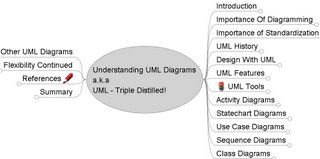
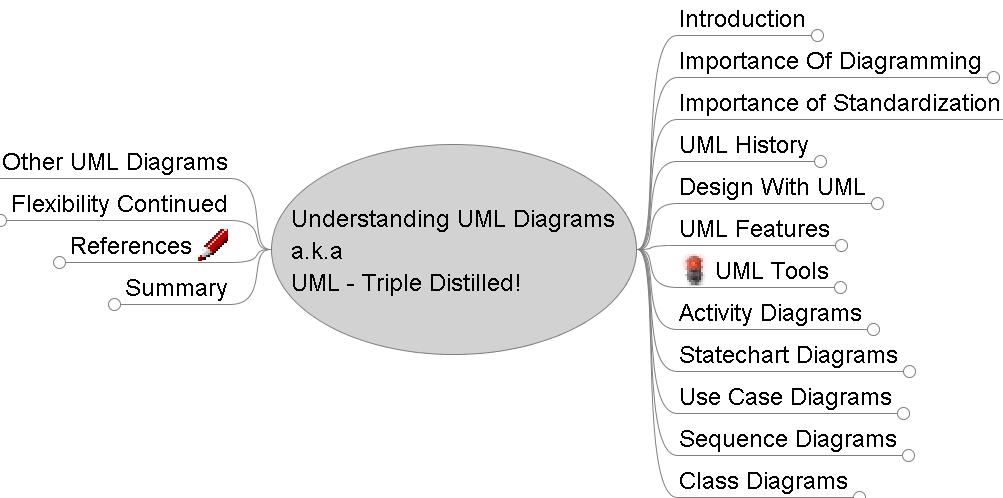
In the coming days, I will be putting up slides from the session over here along with some reflections on the slides. Here's the introductory slide.
The objective of the session was to present the UML from a non object-oriented perspective, as a communication and diagramming tool. People won't often say this, but, really, you don't necessarily have to be an OO guru to benefit from the UML.
In the coming days, I will be putting up slides from the session over here along with some reflections on the slides. Here's the introductory slide.
Wednesday, October 04, 2006
SFINAE
Function templates participate in name resolution for overloaded functions, but the rules are different. For a template to be considered in overload resolution, the type has to match exactly. If the types do not match exactly, the conversions are not considered and the template is simply dropped from the set of viable functions. That's what is known as "SFINAE" — Substitution Failure Is Not An Error.
Monday, September 11, 2006
Subversion - What can be in a name?
Subversion is the configuration management tool that aims to be a replacement for CVS, the older *NIX . It's pretty decent, although it is not all that sophisticated. Just as well, because the project's purpose-statement does not position it as a do-it-all, suitable-for-all-users thing. It just does what it claims to, versioning and does it pretty well.
But what I love about the tool, more than its features and even though the lack of certain features sometimes irritates, is the name: Subversion. I think the name is just charming, to say the least.
First of all, the word "version" is present in the name and versioning is what it does. You could even think of it as a tool that helps manage "sub-versions" of an object. Think "sub-version" instead of version.
If you think the "sub-version" line of reason is juvenile, then take this. "sub-" as a prefix could mean "Under, lower, below, secondary, inferior". Choose the "under" meaning and lo, sub-version takes the "under version (control)" meaning. :-)
But there's more to it The meaning of the word "subversion" is
1. Destroying someone's (or some group's) honesty or loyalty; undermining moral integrity
2. The act of subverting; as overthrowing or destroying a legally constituted government
This refers to Subersion's aim to be a complete replacement for CVS, that of underming the CVS ethos entrenched in *NIX culture.
Thus the name not only describes what the tool does, but it also embeds within it allusions to its history, culture and ultimate goal... and what's more, the mischief is hidden within the multiple possible interpretations.
What's in a name, anyone?
But what I love about the tool, more than its features and even though the lack of certain features sometimes irritates, is the name: Subversion. I think the name is just charming, to say the least.
First of all, the word "version" is present in the name and versioning is what it does. You could even think of it as a tool that helps manage "sub-versions" of an object. Think "sub-version" instead of version.
If you think the "sub-version" line of reason is juvenile, then take this. "sub-" as a prefix could mean "Under, lower, below, secondary, inferior". Choose the "under" meaning and lo, sub-version takes the "under version (control)" meaning. :-)
But there's more to it The meaning of the word "subversion" is
1. Destroying someone's (or some group's) honesty or loyalty; undermining moral integrity
2. The act of subverting; as overthrowing or destroying a legally constituted government
This refers to Subersion's aim to be a complete replacement for CVS, that of underming the CVS ethos entrenched in *NIX culture.
Thus the name not only describes what the tool does, but it also embeds within it allusions to its history, culture and ultimate goal... and what's more, the mischief is hidden within the multiple possible interpretations.
What's in a name, anyone?
Monday, June 19, 2006
Freeware UML Tool
Have found an open-source and freeware tool for making UML diagrams.
It's called StarUML. You can download it from the StarUML.com website.
I used it for sometime and found it to be rather stable and usable. It most definitely is not crippleware. Can't say the same about Poseidon or the other community-edition tools like Visual Paradigm or UMLStudio.
StarUML is definitely recommended, though it is not without its share of glitches.
It's called StarUML. You can download it from the StarUML.com website.
I used it for sometime and found it to be rather stable and usable. It most definitely is not crippleware. Can't say the same about Poseidon or the other community-edition tools like Visual Paradigm or UMLStudio.
StarUML is definitely recommended, though it is not without its share of glitches.
Monday, May 29, 2006
Degenerate Classes
A degenerate class is one that has no methods at all.
In C++ it would have a pure virtual destructor.
In java such classes are called “Marker Interfaces”.
In C++ it would have a pure virtual destructor.
In java such classes are called “Marker Interfaces”.
Decorator Pattern
An example to demonstrate the Decorator design pattern which I had contributed to Wikipedia a few months back. It has since been improved and changed over there but thought maybe I should maintain a copy... Read the latest version from here.
This Java example uses the Window/Scrolling scenario
Typically, the decorator's methods will only pass requests to the underlying decorated component, but it can also perform operations before and after the call. Then the decorator defines extra methods (decorations) to extend the decorated component's functionality.
Using the decorator:
We can add a VerticalScroller decorator to a Window, say, theWindow, by saying
The object, theWindow, will have vertical scrolling functionality after this.
This Java example uses the Window/Scrolling scenario
The decorator is given the same interface as the component it decorates. The decorator must be explicitly mentioned as supporting the Window interface for it to be useful in a real scenario; it must have the same type.
class Window {

      public void draw() {
              // Draw window
      }
      public void setSize(int height, int width) {
              // Set window size
      }

      // Other Window methods
}
Typically, the decorator's methods will only pass requests to the underlying decorated component, but it can also perform operations before and after the call. Then the decorator defines extra methods (decorations) to extend the decorated component's functionality.
class VerticalScroller extends Window {

      private Window myWindow;

      public VerticalScroller (Window baseWindow){
              myWindow = baseWindow; // Save the reference, which we will use
      }

      public void draw() {
              //draw the vertical scroller
              myWindow.draw();
      }

      public void setSize(int height, int width) {
              //implement vertical scroller-specific functionality
              myWindow.setSize(height, width);
      }
}

class HorizontalScroller extends Window {

      private Window myWindow;

      public HorizontalScroller (Window baseWindow){
              myWindow = baseWindow; // Save the reference, which we will use
      }

      public void draw() {
              //draw the horizontal scroller
              myWindow.draw();
      }

      public void setSize(int height, int width) {
              //implement horizontal scroller-specific functionality
              myWindow.setSize(height, width);
      }
}
Using the decorator:
We can add a VerticalScroller decorator to a Window, say, theWindow, by saying
      theWindow = new VerticalScroller (theWindow);
      //A vertical scroller gets added to theWindow
      //Constructor internally saves a reference to the old undecorated theWindow
The object, theWindow, will have vertical scrolling functionality after this.
Subscribe to:
Posts (Atom)